
So a road bike, huh?
Have you been doing most or all of your training rides on your tri bike? Awesome! That's a great start. But did you know that we actually recommend doing the majority of your training on a road bike? Yep, it's true. And in this blog, we're going to explore why a road bike might just be a triathlete's most important and underrated tool.

Understanding the Difference Between a Road Bike and a Tri Bike
We actually have a YouTube video that goes more in-depth on the key distinctions between the two, linked HERE. But in short, the main differences come down to geometry, handling, and use case.
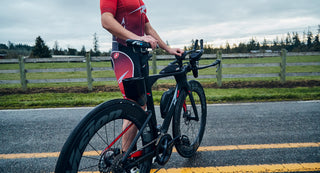
The geometry of a road bike is going to be much more comfortable than a tri bike, especially after a proper fitting. This is mainly because of the more upright riding position that comes from the pushed-back seatpost and bottom bracket geometry. That more comfortable position also translates directly to better handling. With the option to ride on the hoods, drops, or flats, a road bike gives you far more versatility to handle different situations on the bike, whether that's a steep climb, a fast descent, or a stretch of rougher terrain.
A tri bike, on the other hand, doesn't have the same handling characteristics. However, it more than makes up for it in straight-line speed thanks to its aggressive aero position and aerodynamic design.
So in many ways, one bike really can't replace the other. They're built for different occasions. But let's explore why you shouldn't only have a tri bike in your arsenal when it comes to triathlon training.

The Case for Training on a Road Bike
So why train on a road bike the majority of the time? For starters, it builds a better overall cycling foundation. A road bike naturally engages more muscles as you ride — your quads, glutes, hamstrings, and calves are all working harder than they would in an aero position. That means just by riding your road bike more consistently, you'll get more muscle output when you eventually hop on your tri bike for a similar course. That strong foundation translates directly to greater strength and endurance on race day, and it also teaches you proper pedaling mechanics that aren't dependent on your aero position.
Second, road bikes are simply the safer and more practical option for the majority of your training rides. Let's paint a picture. Your friends invite you on a group ride with six or more riders. First of all, don't show up on a tri bike (It's culturally unacceptable). But more practically, a road bike is going to give you the handling you need to make quick maneuvers within a group. Then your ride takes you through some traffic, where you need to react quickly and navigate carefully — a road bike handles this with ease. And then, as group rides always seem to do, someone suggests hitting a little gravel path on the way back. We both know a tri bike is not surviving that.
A road bike handles all of those scenarios effortlessly. But honestly, the bigger lesson here is that being exposed to those kinds of situations is genuinely valuable. It teaches you how to react, how to ride safer, and how to be more prepared for the unexpected out on the race course. And life's too short to experience it all from an aero position.

When Should You Actually Get on Your Tri Bike?
So you've committed to doing most of your training on a road bike (great call). But then race day starts creeping up, and you realize you've almost forgotten what it feels like to be locked into aero. So let's talk about when you should be getting on your tri bike, because yes, you absolutely should still be riding it.
We recommend getting on your tri bike for race-specific workouts, simulations, and trainer rides. Whether that's a structured time trial effort, a transition simulation, or a race-pace interval session, your tri bike is the right tool for those moments. There should be designated workouts in your training plan that call for your tri bike, and those are the sessions to lean into it.
It also wouldn't hurt to start shifting more of your workouts to the tri bike a couple of weeks out from your race. This helps bring back the feel of holding aero position for an extended period, and it's a great opportunity to dial in any last-minute fit tweaks or setup adjustments before race day.
Our overall recommendation? Keep your tri bike on the trainer for most of your training schedule. On the days you can't get outside, use the tri bike indoors. You get the race day simulation without the complications of navigating it on open roads. That said, we always encourage getting outside as much as possible during your training block. There is simply nothing like training in the real elements, like wind, heat, hills, and all.

What to Look for in a Triathlon Training Road Bike
Not all road bikes are created equal when it comes to triathlon training. Here's what you want to look for:
First, prioritize geometry that is comfortable for long miles. You're going to be spending a lot of time in the saddle, so an endurance-focused geometry that keeps you comfortable without sacrificing responsiveness is key.
Second, look for something lightweight and nimble. Triathlon training should take you up climbs, down descents, and through varied terrain. Therefore, your chosen road bike should feel quick and confident in all of those conditions.
Third, versatility matters! The best triathlon training road bike should be able to handle road, chip seal, light gravel, and everything in between without struggling for stability.
The A2 Rogue checks every one of those boxes (yep, you should have known this was coming). Built with an endurance-focused geometry, lightweight construction, and the versatility to handle whatever road you throw at it, the Rogue was designed from the ground up with the triathlete's training life in mind. It's not just a road bike — it's your training partner from the first ride of the season all the way to the start line.

Conclusion
At the end of the day, becoming a better triathlete isn't just about logging miles on your tri bike. It's about building a well-rounded, strong, and adaptable cycling foundation, and a road bike is the best tool for that job. Save the tri bike for when it matters most, and let your road bike do the heavy lifting in between.
Train smart. Show up ready. And if you're looking for the perfect road bike to take your triathlon training to the next level, the Rogue is waiting for you.